Capitalism and Development
By Gabriel Cepaluni · Cambridge University Press, 2026 · 321 pp.
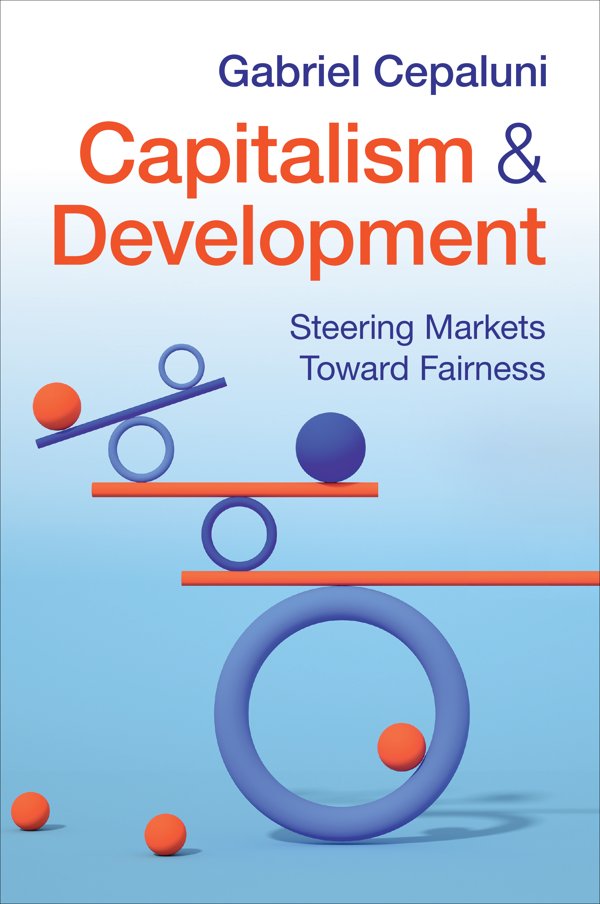
Why do some economies turn markets into broad prosperity while others turn them into privilege? The book proposes a framework, Fair Market Institutionalism, that builds on Adam Smith, Milton Friedman, Friedrich Hayek and James Buchanan's constitutional economics, together with the institutionalist work of Douglass North and Daron Acemoglu. It argues that markets create abundance, and that the rules a democracy writes decide who shares in it.
Cambridge University Press Cambridge Core Kindle
Paperback ISBN 978-1-009-84407-9
Contents
| 1 | The Populist Gamble: Short-Term Gains, Long-Term Decline |
| 2 | The Growth Dilemma: Why Some Nations Prosper while Others Stagnate |
| 3 | Illusions Shattered: Socialism's Promise, Populism's Chaos, and Liberal Hope |
| 4 | Locked in Stagnation: Latin America's State-Controlled Development |
| 5 | The State as an Architect of Progress: Risks and Rewards of Intervention |
| 6 | The Urban Paradox: Progress, Governance, and Inequality in Global Cities |
| 7 | Building Prosperity: Ideas Drive Innovation |
| 8 | Global Justice: Power, Fairness, and Sovereignty |
| 9 | Human Capital: The Foundation of Lasting Prosperity |
| 10 | Corporate Titans: The Modern Power Elite |
| 11 | The Path Forward |
Related writing
Capitalism Creates Abundance. Democracy Must Share It (Cambridge University Press Blog, July 2026).